
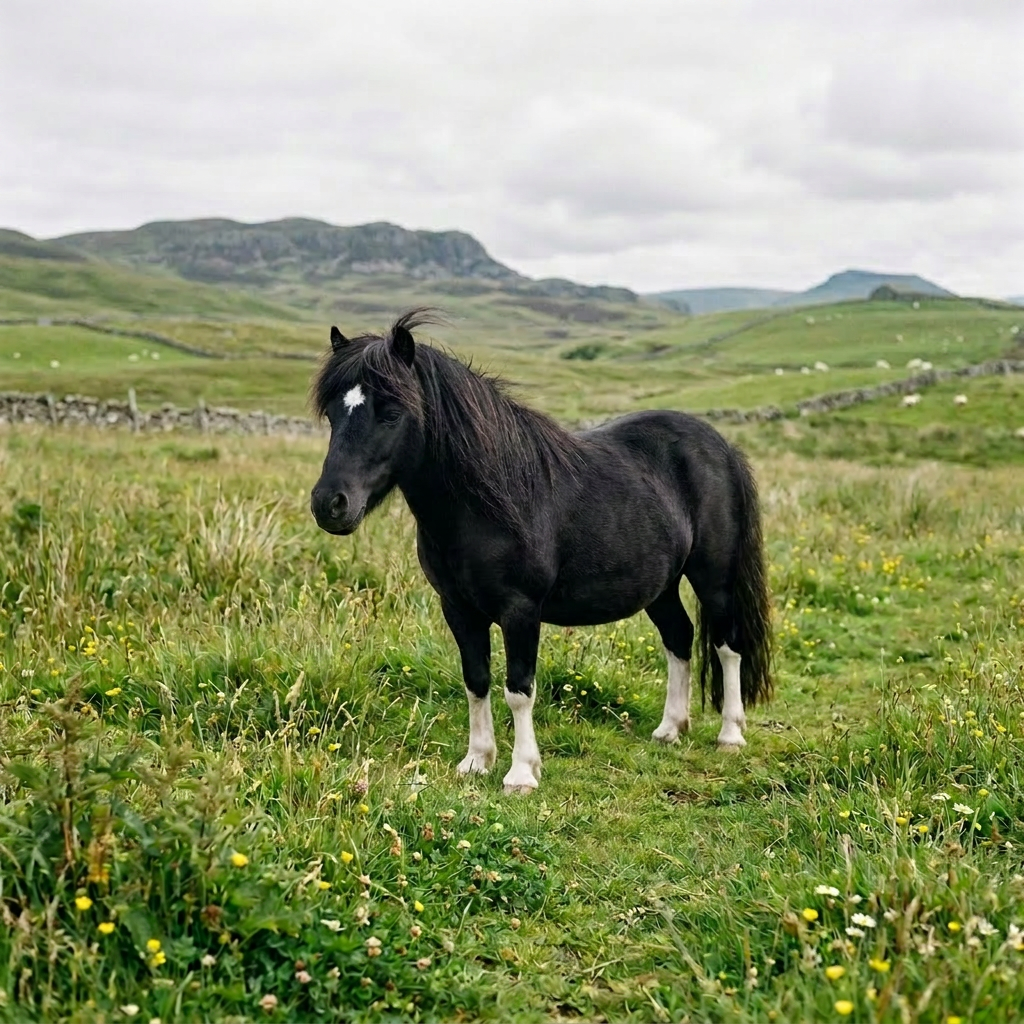
A Shetland pony is a small but sturdy breed of horse originating from the Shetland Isles in northern Scotland. Here are the key characteristics:
Size and Build Shetlands are among the smallest horse breeds, typically standing between 71 and 107 cm (28–42 inches) at the withers. Despite their diminutive stature, they are heavily built with short legs, a broad head, a deep girth, and a thick neck. They’re surprisingly strong relative to their size — historically, they could pull considerable loads.
Coat and Appearance They have a dense double coat that helps them survive harsh island winters. Their manes and tails are thick and long, and they come in nearly every equine color, including black, chestnut, bay, grey, palomino, and various pinto patterns.
Temperament Shetlands are known for being intelligent, hardy, and sometimes stubborn — a trait that reflects centuries of survival in a tough environment with limited forage. They can be gentle and affectionate with proper handling, but their cleverness means they can also be mischievous.
History and Uses They evolved in isolation on the Shetland Isles, where harsh conditions shaped their hardiness and small size. During the Industrial Revolution in Britain, thousands were sent underground in coal mines as pit ponies, hauling carts through narrow tunnels. Today, they are popular as children’s riding ponies, in driving competitions, and as companion animals.
Their combination of strength, resilience, and compact size makes them quite remarkable for such a small animal.
 Pony Pointer's Blog